
Building the Loop Behind Personalized Supplementation
My wife and I are trying to get pregnant, and like a lot of couples in that position, we quickly ended up with more health data than we knew what to do with. So I built Alma, a dashboard that brings it all into one place. What started as a side project turned into a working model of something OK Capsule thinks about every day: how a health recommendation becomes something a person takes daily, and how it gets better over time.
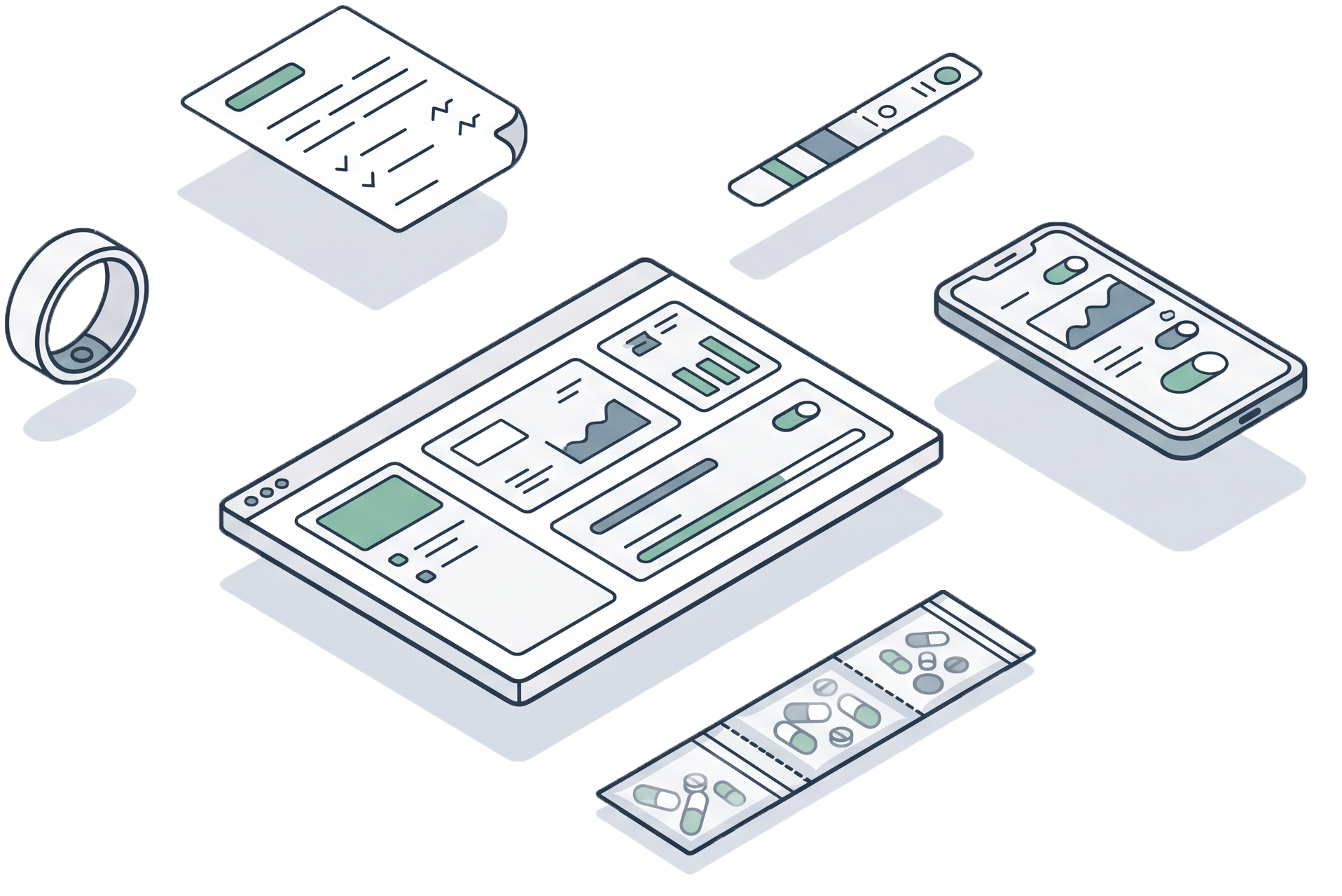
The system comes down to four steps: test, get results, add supplementation, test again.
The problem: plenty of data, no loop
A hormone tracker says one thing. A wearable says another. Lab results sit in a PDF. Each source is useful on its own, but none of them connects to what you do the next morning. And even when a result does point to a change, there's usually no clean way to act on it, track whether it was followed, and check whether it made a difference.
That's the gap. Not a lack of information, but a lack of a loop.
Step 1: Test
Alma pulls together Mira hormone-tracking data, Oura stress and sleep data, Apple Health, and lab results into one view. Instead of opening four apps and trying to remember what happened and when, everything sits on the same timeline.
Step 2: Get results in context
A hormone reading is one point in a cycle. A stress score is one piece of a day. Seen together, they make it easier to follow what's happening and bring better questions to her doctor. The dashboard organizes the information; decisions about her health stay with her and her care team.
Step 3: Add supplementation
This is where the loop usually breaks, and where OK Capsule comes in.
Alma's supplement regimen runs through Perfect Packs, the demo storefront built on OK Capsule's MCP. A protocol goes in, gets checked against cumulative ingredient limits across the whole order, and comes out as personalized daily packs, organized by time of day and manufactured in a cGMP-certified, FDA-registered facility.
What made this part interesting to build is that it connects a digital experience to something physical. The recommendation doesn't end with a shopping list. It ends as a pack she can take with breakfast.
Making it part of the day
A protocol only works if it's followed. Alma keeps the daily routine visible: the pack for the morning, a quick symptom check-in, a meal log from a photo (an estimate, clearly labeled as one), and meal ideas from a photo of what's in the fridge. Each of these is a small input, and each one adds context for the next review.
Step 4: Test again
This is the part I'm building next, and it's the part that matters most:
Testing → updated supplements and routines → daily follow-through → testing again.
The full loop isn't live in Alma yet. The idea is that new lab results, hormone readings, and daily check-ins feed a review of the plan. When her clinician agrees a change makes sense, the updated protocol flows into the next order, and follow-up testing shows what changed.
The fulfillment side of that loop already exists. Through the OK Capsule MCP, an order can be updated and tracked, while her health data stays in Alma. The work left on my side is the review step: deciding when the data says it's time to revisit the plan.
Hormones change throughout the month, so the support should be able to change with them, on a schedule that makes sense, with a person reviewing every adjustment.
Why this matters beyond one dashboard
Alma is a personal project, but the loop isn't specific to us. The same cycle applies anywhere testing and supplementation meet: a practitioner reviewing a patient's labs, a testing company returning results, a telehealth platform following up with a customer. The testing and the clinical judgment sit on one side. Manufacturing and fulfillment sit on the other. The MCP is what lets a change on one side show up on the other, so an updated protocol becomes the next shipment.
Building this for my own family made one question impossible to ignore: does this actually help the person using it? So far, the answer has less to do with any single feature and more to do with the loop itself: test, adjust, follow through, and test again.