
Customer Value Is More Than Money
Last week, I argued that your ideal customer can be a business outcome: instead of only finding the customers you want, you can intentionally develop them. That raises a second question. If customers are developed through the relationship, what exactly is being exchanged between the customer and the business—and how should we think about the value created on both sides?
Business is an exchange of value. The most obvious part of that exchange is money.
A customer gives you $125. You give them a product. Because money is easy to count, businesses have built sophisticated systems around measuring it: revenue, margin, average order value, customer acquisition cost, lifetime value and churn.
Those measures matter. Ultimately, a commercial business needs the value it creates to show up economically.
But the $125 transaction is often only the most visible part of a much larger exchange.
The same customer may also start a subscription, refer three friends, leave a review, explain why she almost cancelled, answer a survey, provide useful data or explain your product to someone else more convincingly than your advertising ever could.
Each of those actions can create economic value. Yet most businesses still treat them as secondary to the financial transaction rather than as part of the same system.
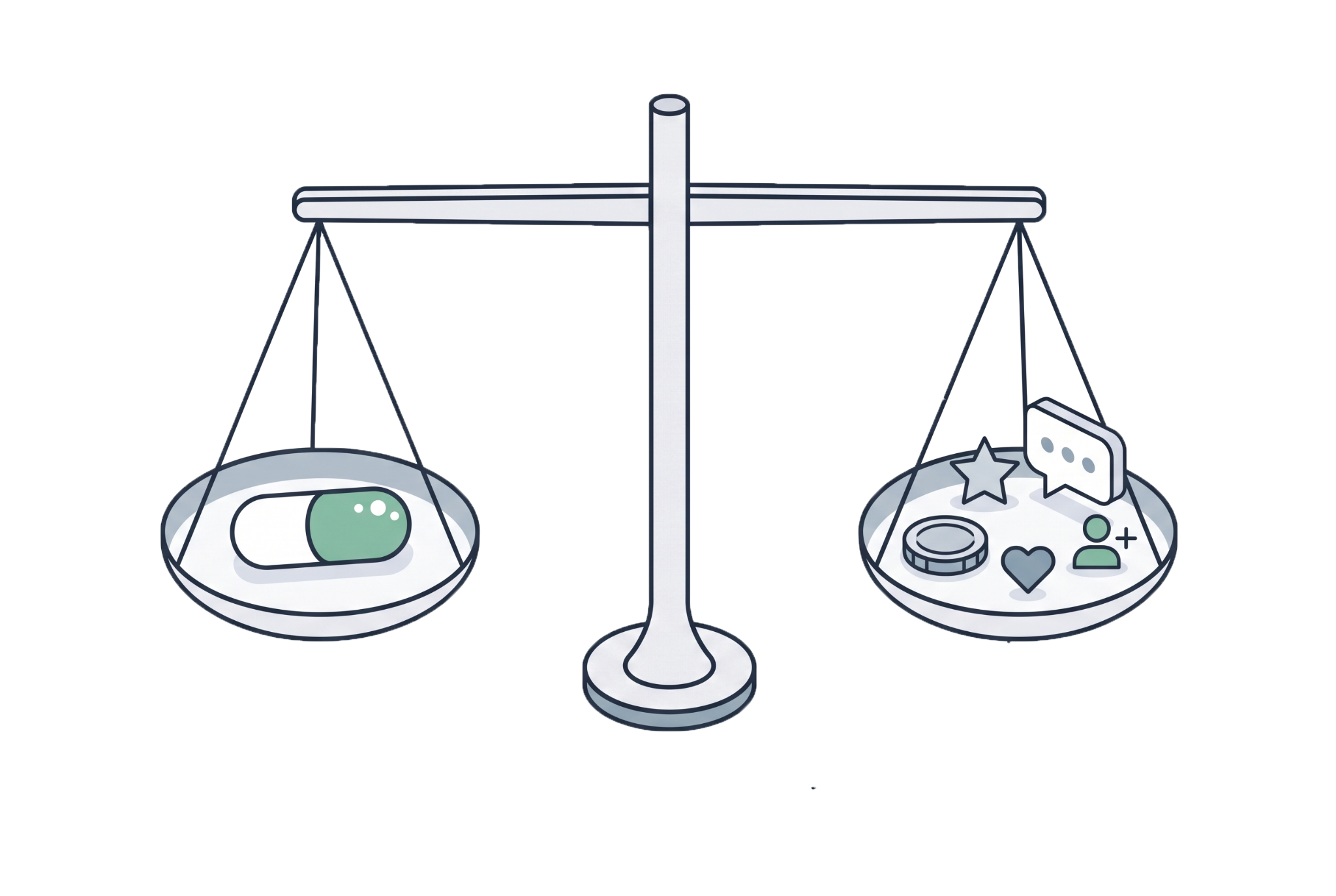
Money is the outcome. A lot happens before it arrives.
Suppose a customer starts a subscription worth $125 this month. If she remains subscribed for four months, that initial action has now produced $500 in revenue.
Or suppose you spend $5,000 on a referral program and it generates 100 new customers.
Your referral program just generated customers at a $50 acquisition cost. (Current supplement industry benchmark CAC is $125.)
Customer feedback may reveal demand for a product you had not considered. Better first-party data may make advertising more efficient. A useful review may increase the conversion rate of customers who encounter it later.
Each example ultimately returns to business economics, but not immediately.
There is an intermediate sequence:
Customer action → value created → economic impact
That middle portion is where a surprising amount of enterprise value is created, and it is often poorly understood.
Customer Value is broader than revenue
Revenue is the easiest form of Customer Value to recognize, but mature customers can create value in many other ways: retention, purchase frequency, referrals, reviews, useful feedback, first-party data, content, advocacy, community participation, credibility and word of mouth.
These are not interchangeable currencies.
A referral is not money. Data is not money. A positive review is not money.
Their importance comes from what they eventually do to the economics of the business.
A referral can reduce customer acquisition cost. Better data can improve marketing efficiency. Feedback can improve the product. Advocacy can increase conversion. Retention can materially increase lifetime value.
The useful question, therefore, is not simply:
How much money does this customer give us?
It is:
What does this customer do that creates value for the business, and how does that value eventually show up economically?
That gives us a much richer definition of Customer Value.
The exchange runs in both directions
Businesses are very good at asking customers for things.
We ask them to buy, subscribe, refer a friend, provide an email address, complete a survey, leave a review, follow us, share more data and consider the next product.
The less frequently asked question is why the customer should do any of those things.
That is the other side of the exchange.
Some Brand Value is straightforward. The product needs to work. Service needs to be competent. Delivery needs to be reliable. A company needs to perform the basic functions the customer entered the relationship expecting it to perform.
But the relationship can also create additional value.
A skincare company can help customers understand how to go from good to glowing. A running company can help customers reach a new personal best. A cooking brand can facilitate exploration into cuisines from an ocean away. A software company can help its customers save time and reduce costs.
In each case, the customer receives more than the product itself. The relationship can increase the customer's ability to derive value from what the company provides.
That change in capability can change behavior.
A customer who understands a product better is more likely to use it consistently. Consistent use increases the value they receive from the product. Greater value strengthens retention. A satisfied retained customer will become increasingly confident recommending the company to others.
The relationship begins to compound.
The Value Exchange
At its simplest, the relationship can be represented as:
Brand Value ⇋ Customer Value
The company creates value for the customer. Through their subsequent actions, customers create value for the company.
The objective is not to maximize how much value can be extracted from customers. It is to understand what the business must create for customers in order for commercially valuable behaviors to become more likely.
If you want customers to stay longer, what makes the relationship more valuable to stay in?
If you want referrals, what makes someone confident enough to put their own reputation behind recommending you?
If you want better data, what does the customer receive in exchange for sharing it?
If you want customers to adopt more of your product range, what makes those additional products genuinely useful to them?
A strong Value Exchange is reciprocal. More value created for the customer should create the conditions for greater value to be returned to the business.
Traditional measurement often begins too late
Most companies already possess a great deal of information about these exchanges.
They know what customers buy. They can see email engagement. They may be able to trace referrals. They can read reviews, support tickets and survey responses. Larger organizations may have years of CRM history, transaction data and qualitative research.
Historically, the difficulty has been bringing those signals together into a coherent picture of how value develops across a customer relationship.
For a small business, that does not require sophisticated technology. The exercise at the end of this article is enough to begin identifying the behaviors that matter and connecting them to business outcomes.
At greater scale, the analytical problem becomes more difficult. Millions of customer actions may be distributed across transactional systems, CRM platforms, support conversations, surveys, referral programs, content engagement and other sources.
This is where AI becomes relevant.
Large language models make it increasingly practical to work across structured and unstructured customer information at the same time. They can help organizations identify recurring themes in qualitative feedback, classify behaviors, connect customer language to transactional history and surface patterns that would previously have required large amounts of manual analysis.
AI does not make the Value Exchange possible.
It makes the same logic more operational at scale.
The underlying principle remains the same whether you have fifty customers or five million:
Traditional business measurement often starts when the money moves. Customer Value Strategy starts earlier, by identifying the behaviors and exchanges that cause the money to move later.
Map the exchange in your own business
Take 20 minutes and draw three columns.
1. What value do we create for customers?
Do not list features. List the actual value customers receive.
That might include product quality, convenience, expertise, confidence, access, knowledge, a simpler routine, better decisions, community, status or reassurance.
2. What value do our best customers create for us?
Begin with purchases, but keep going.
Do they stay longer? Reorder more frequently? Refer others? Provide useful feedback? Share data? Write reviews? Advocate for the brand? Create content? Introduce other customers? Increase the credibility of the company or category?
3. How does that Customer Value create economic value?
Draw the connection explicitly.
Referral → new customer → lower CAC
Better data → more relevant marketing → higher conversion
Subscription → greater retention → higher LTV
Feedback → better product → stronger retention
Advocacy → greater trust → higher conversion
You do not need a sophisticated financial model to begin. The objective is simply to make the exchange visible.
Then ask one final question:
Which economically important parts of this exchange are we deliberately designing—and which are we leaving to chance?
This is where the exercise gets uncomfortable.
A company may say referrals are critical to growth and then have no meaningful referral experience.
It may say customer data is strategically important while giving customers no compelling reason to provide better data.
It may depend heavily on retention while devoting most of its marketing attention to acquisition.
It may know that informed customers get better results and stay longer, while leaving customer education to a few forgotten help-center articles.
These are not necessarily failures of execution. Often, nobody has ever put the whole exchange on the same page.
Once you do, priorities become easier to see.
The point is not to optimize every interaction or measure every conceivable form of Customer Value. It is to identify the parts of the exchange that matter most to the economics and future of the business, and then ask whether you are actually doing anything to make them happen.
Some will already work beautifully. Leave them alone.
Some will matter very little. Ignore them.
And some will turn out to be economically important behaviors on which the business is effectively relying on luck.
Those are interesting.
The next question is how to find them in the real operation of the business: where the customer acts, where the company acts in response, which systems and people are involved, where friction appears and where value is lost or amplified.
That is where the customer journey becomes useful.
Not because every company needs another journey map.
Because once you know which exchanges matter, the journey tells you where to intervene.