
Designing Supplementation That Survives Real Life
The cabinet of good intentions
Open almost any kitchen cabinet and you'll find it: the bottle graveyard. A magnesium that made it to week two. A vitamin D with a receipt still in the bag. Something a practitioner recommended with real conviction, now quietly expiring behind the olive oil.
Nobody planned that. The recommendation was sound, the purchase was sincere, and then Tuesday happened. Then a flight, a night shift, a week at your in-laws'.
This isn't a supplement problem so much as a human one. When the World Health Organization looked at people on long-term regimens, it found adherence in developed countries averages only 50%. Half. Even when the recommendation is clear and the person fully intends to follow it, everyday life gets in the way.
So the most important ingredient in any protocol isn't on the label. It's whether the thing gets taken.
Why we started: remove the friction
Seven years ago, we started OK Capsule on a simple bet. If you put high-quality supplements into a format that makes a clinician's recommendation ridiculously easy to follow, people will follow it.
We saw two kinds of friction getting in the way.
Mental friction. Which bottle is this? Did I take it already? Is this even the right one, or the one from the old plan? Every open question is a small but important reason to skip.
Physical friction. Five bottles, five caps, five different serving sizes, every morning. Some people solve this by sorting pills into weekly organizers or tiny zip bags, which works right up until the Sunday they don't feel like playing pharmacist.
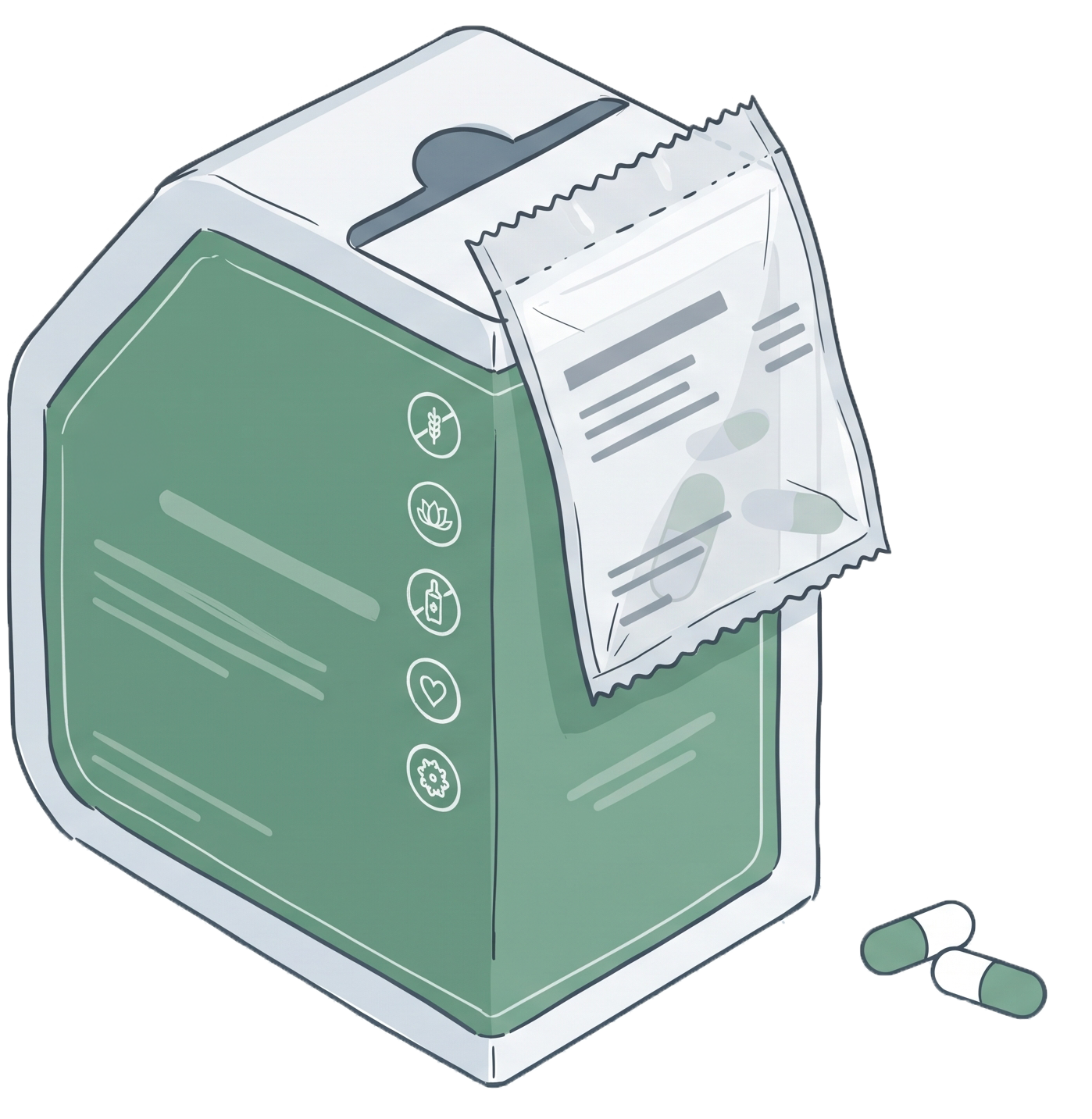
Our answer was the pack: each serving sealed together, labeled with the person's name. No sorting, no counting, no guessing. Tear, take, done.
It's an old idea with decent evidence behind it. A Cochrane review of reminder packaging found it raised the percentage of pills people took by about 11 points, with results that varied from trial to trial. Packaging doesn't make anyone more disciplined. It just takes away the excuses.
Where the pack really earns its keep: off the kitchen counter
Home is the easy case. Same counter, same coffee, same time every morning. Most supplement design assumes that life.
The harder test, and where individually sealed packs do their best work, is the routine that keeps getting broken.
The traveler. Traveling with supplements usually means a bag full of bottles, or a pile of zip-locks with pills nobody can identify by day four. OK Capsule's packs skip both: count out one per day, drop them in your bag and go.
The gym-first crowd. For people who shower, change and start the day at the gym, the routine lives in a locker, not a kitchen. A pack rides in the gym bag next to the deodorant and gets taken at the same point every day, wherever that day starts.
Shift workers. Nurses, pilots, warehouse teams and anyone on rotating schedules know that "take with breakfast" means nothing when breakfast is at 7 p.m. One pack per serving keeps the routine tied to the person, not the clock on the wall.
Remote and rotational crews. Oil platforms, mining camps, field research stations, long-haul routes. Weeks away, limited storage, food that's whatever the galley is serving. Packing a month of bottles is bulky and easy to get wrong. Packing a month of sealed servings is a box.
The pattern across all four: when the setting changes, the routine shouldn't have to be rebuilt. Each sealed serving is the routine, already assembled.
And because packs are built per order, a routine doesn't have to stay frozen either. Through the MCP and the OK Capsule API, a customer's pack can shift for a trip or a demanding stretch, so the routine adapts instead of breaking.
Why adherence is a business model, too
For a practitioner or a brand, a recommendation that sits in a cabinet is a quiet failure twice over. The client didn't get what you recommended, and they probably won't reorder something they never finished.
Packs change that in two ways.
The protocol gets followed as written. Every serving is already built to the recommendation. Nothing gets dropped because it was the annoying bottle with the stuck cap.
Finishing leads to continuing. Someone who actually works through month one is in a much better position to start month two. Put that on a subscription and the next pack shows up before the last one runs out. No reorder decision, no gap.
The health side and the business side point the same way here. Remove the friction from taking the supplements, and people stay with the plan their practitioner built. That's good for them, and it's good for the brand whose name is on the pack.
The other kind of friction: trust
Convenience only matters if what's inside the pack is what the label says. That was the second half of the founding bet, and it's the part we're most stubborn about.
Third-party testing on every fifth batch.
Certificates of analysis behind the ingredients we pack.
Traceable sourcing down to the ingredient level.
FDA-registered, cGMP-certified facilities, with 100% US manufacturing.
The brands we work with put their name on every pack. That only works if they never have to wonder what's in it. Seven years of packing to spec is the part of this story we'd call boring, and we mean that as a compliment.
What you can build on it now
For most of our history, getting a personalized pack in front of a customer meant working with us directly. That's changed. Three pieces of the platform now let brands build adherence into their own products.
The MCP. Our Model Context Protocol server lets an AI assistant talk directly to a brand's formulary and fulfillment. A conversation about goals, labs or a practitioner's plan can become a personalized pack, built to spec and shipped, without anyone re-keying an order.
Shopify, with subscriptions. Our Shopify integration is more capable than it's ever been, including recurring orders. Packs arrive on schedule, and a customer's routine doesn't depend on remembering to reorder.
The API. Anyone can build on it, and with today's AI web-building tools that no longer requires a development team. A practitioner can stand up a simple intake that turns into a pack. A coach can offer travel-ready routines for clients on the road. A company running crews offshore can set up a standing order for each rotation.
The idea from seven years ago hasn't changed: make the recommendation easy to follow, wherever the person happens to be. What's new is how many people can now build that experience themselves.
These statements have not been evaluated by the Food and Drug Administration. This product is not intended to diagnose, treat, cure, or prevent any disease.
Sources
World Health Organization, "Failure to take prescribed medicine for chronic diseases is a massive, world-wide problem", July 2003. Average adherence of 50% in developed countries.
Mahtani KR, Heneghan CJ, Glasziou PP, Perera R, "Reminder packaging for improving adherence to self-administered long-term medications", Cochrane Database of Systematic Reviews, 2011. Pills taken rose by a mean of 11 percentage points (95% CI 6–17), with high variation between trials.