
The Doctor's Context Window Just Got Bigger
When I was younger, a dermatologist diagnosed me with psoriasis. A chronic condition where small patches of my skin decide to get red and inflamed and peel off into neat little scales. I was never satisfied with the consensus from multiple dermatologists that psoriasis is entirely genetic and the only treatment is steroids. The pattern felt infectious to me. Like my skin was being slowly colonized by a foreign invader. So I asked Claude, and the series of events that followed were so simple, yet so profound.
A physician holds a few hundred facts in working memory on a good day and misfiles half of them under stress, fatigue, or the simple entropy of having learned too much for too long. This is not a failing of any particular doctor. It is the architecture of how human brains process information. The human mind files things by when it learned them, not by when it will need them, and the gap between those two moments is where most clinical reasoning quietly dies. But that is only half of the problem.
Because Claude had my raw DNA data, my last five years of blood work, and random knowledge about my lifestyle, when I asked it a benign question about how to treat psoriasis, the answer was anything but.
I asked Claude to prove or disprove my infectious organism theory, and it quickly filled me in on a few specific genetic variants I carry that cause my skin to overreact to a common yeast that everyone carries. So were the dermatologists correct? Probably. But without knowing why.
As Claude helped me identify the offending yeast, Malassezia, and its downstream byproducts that I like to overreact to, I thought, great, I will just treat it with a common antifungal. Claude agreed in principle but disagreed with my choice. I was about to prescribe myself fluconazole. Claude once again referenced my specific genetics, recent blood work, and the other molecules I was ingesting currently. I had overlooked this entirely. Not out of laziness. My own context window simply did not consider this level of detail. We landed on a lesser known drug called terbinafine instead, because it is kinder to my liver and my specific gene variants without a meaningful treatment compromise. It's a more reasonable starting point.
We also agreed that Low Dose Naltrexone would be a good option to reset the overproduction of inflammatory interleukins, again based on my genetics.
After ten years of failed advice from so-called experts, I have a treatment that makes theoretical sense based on a dozen personal data points, and it moved the needle in practice.
The thing a doctor never actually had
Every physician has, in theory, access to a patient's full picture. The labs. The medication history. The genetic data, if it exists. The longitudinal patterns across years of visits. In theory.
In practice, no clinician can hold all of that at once. There is a complaint in front of you, a handful of recent values, and whatever your memory surfaces in the time you have before the next patient. The genome sits in a file you skimmed the summary of once. The labs from 18 months ago are a PDF in a portal you have to log into twice. The drug interaction hidden in the genetic data is real and documented and completely absent from your mind at the moment you write the prescription, because no human brain can keep a few hundred variants cross-referenced against a medication list cross-referenced against baseline organ function, all live, all at once.
That is not a knowledge problem. It is a working memory problem. The knowledge was always there. The capacity to assemble it inside the moment it mattered was not, and could not be, without augmentation.
I think we are already cyborgs and have been for a while. I wear glasses to augment the limitations of my own biological vision. I have kept a supercomputer in my pocket for more than a decade and outsourced my storage and recall to it without a second thought. Nobody calls that a crisis. Nobody writes op-eds about the glasses coming for the optometrist's job.
I hear a lot of fear-mongering about AI replacing doctors. I am not one of those people, for two reasons.
First, we are in a serious primary care deficit. How long do you wait to see yours? How many minutes do you get when you arrive? Do you walk out feeling like anyone assembled the whole picture of you, or like you were pattern-matched against the last forty people who came in with the same complaint?
Second, the number of primary care physicians in this country has been falling for years, for reasons nobody is solving quickly. The pipeline is not refilling. The ones still practicing are doing it under a documentation burden that would have been called malpractice a generation ago.
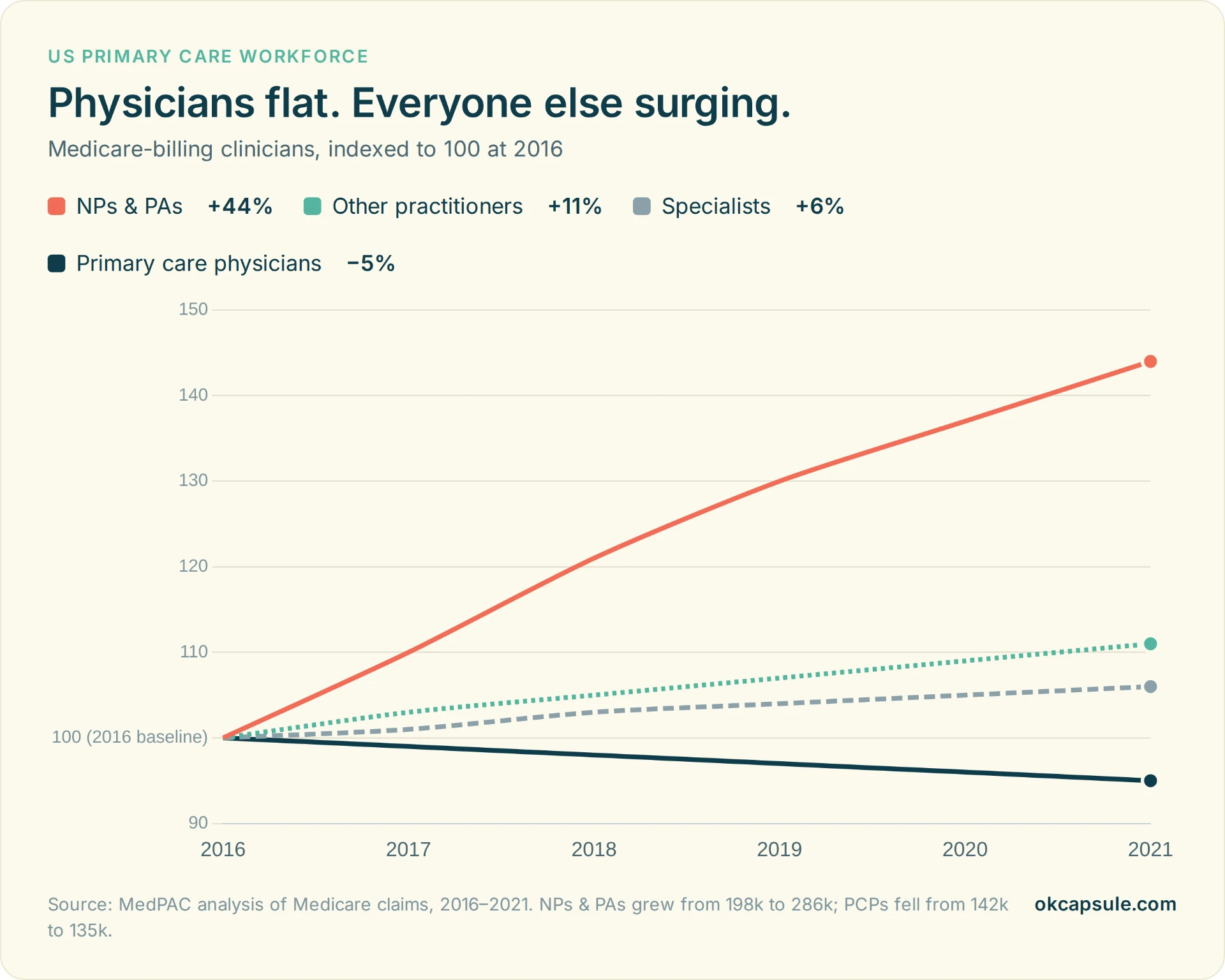
AI lets a single engineer ship what used to take a team of 10. For doctors, I believe it lets us make better decisions, for more patients, in less time.
AI is the solution, not the problem.
This is the change, and it is worth being precise about what kind of change it is. An AI model may or may not know more medicine than a good physician. That is beside the point. What it can do is hold more of the physician's own reasoning in view while simultaneously holding a mountain of patient-specific data. It has a context window the size of a house. The human brain has one the size of a well-organized piece of paper, on a day when nobody is bleeding.
Watching it happen on my own data
The abstraction is easy to nod along to and hard to actually believe until you watch it run on your own labs.
I put my genome and my blood work in front of a model and asked it to reason about my skin. It started from a single line in a spreadsheet of a few thousand. A variant in VDR, the vitamin D receptor gene.
Here is what I forgot I learned in medical school over a decade ago and was kindly reminded of: VDR signaling drives keratinocytes to produce cathelicidin, an antimicrobial peptide that is the skin's own surface-level defense. Reduced signaling means a quieter defense. A quiet defense is an invitation. What accepts the invitation is a common lipophilic yeast that drives seborrheic dermatitis in some people and worsens psoriasis in others.
From there it kept going, and the going is the point. Through the rest of my stack. Suggested labs to confirm the theory. Pharmaceuticals, with the metabolism flags I would have missed. Supplements, dosed to the gaps the blood work actually showed. Follow-ups. The science gets thick fast, and I will spare you the rest of the wade. What matters is that the reasoning did not stop at the diagnosis. It kept assembling, the way I would have if I could hold three hundred facts in my head at once and never get tired.
I want to be careful here, because I sell supplements for a living and I take the ones I sell, and a doctor in my position claiming an LLM cured his skin is exactly the kind of confident voice this whole essay is suspicious of. So: n=1. This is my own data, my own body, my own bias walking into the room ahead of me. I am not telling you what to do with your psoriasis. I am telling you what it felt like to finally have the full picture assembled, by something other than the experts.
One last piece worth mentioning is that when any new symptom pops its head up, Claude makes it very easy to narrow down the offender. I am constantly trying new pills, peptides and lifestyle hacks, where my hunch is often not rooted in as much fact as Claude is, because I'm not aware of all the potential downstream consequences of a new molecule the way an AI is.
Ten years of dermatologists told me my skin condition was genetic and to manage it with steroids. They were not wrong. They just never had the working memory to tell me why, or to notice the one variant that would have changed the prescription. The information was sitting in a file on my computer the whole time. It took a machine with a context window the size of a house to read the file out loud at the exact moment it mattered.
Fear says AI is coming for our jobs. I keep landing somewhere quieter and more hopeful. It is not coming for the work of a physician. It is finally letting us physicians do the work we were always supposed to be doing, and we haven't been doing alone since we started using PubMed.
These statements have not been evaluated by the Food and Drug Administration. This content is for informational purposes only and is not intended to diagnose, treat, cure, or prevent any disease.