
Twelve Bottles on the Counter, and Counting
Walk into the kitchen of anyone serious about their health and you will find the graveyard. Twelve bottles on the counter, maybe fifteen, arranged with the optimism of someone who believed, at the moment of purchase, that they would take all of them for as long as it takes. Most bottles are half full. A few have expired. The zinc is somewhere in a drawer because it upset a stomach once and never got a second chance.
This is what a good protocol looks like after it meets a real human life. This is not a clinical failure or a logistics failure. The advice was sound. The swallowing simply did not happen.
I spent years as a practitioner writing those protocols. I thought recommending a stack meant handing someone a list and trusting them to order it, remember it, and keep at it twice per day for the rest of their treatment. I believed in the model. I still believe in the intent behind it.
The intent was never the problem.
Here is what I kept seeing. A patient comes in, we run the labs, we build something specific and thoughtful, methylated B vitamins because a chunk of the population cannot process the cheap synthetic form, chelated minerals instead of the oxides that pass through you mostly unabsorbed, the right doses at the right times. Good medicine. Then the patient goes home and becomes a warehouse manager. Twelve SKUs, twelve caps to unscrew, twelve reorder dates, twelve chances to quit. By the two week mark, adherence has quietly collapsed and nobody has told me, because people do not schedule a follow up to confess their failure.
The formula was correct. The format was a wall.
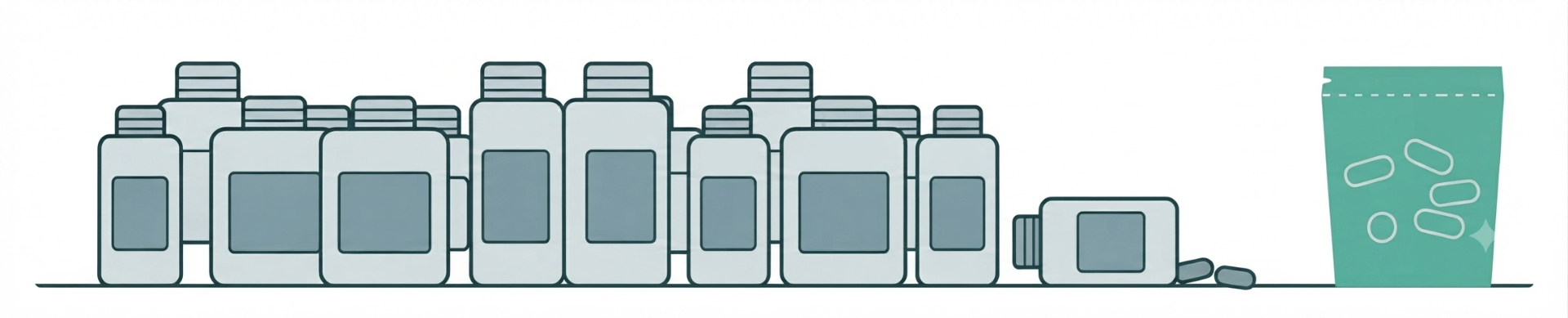
Friction was the blocker. Not motivation, not education, not price. Friction. And once I saw it that way, I could not stop noticing that the supplement industry had done essentially nothing about it in fifty years. The pill in the bottle I was recommending in 2015 was, as a physical experience, the pill in the bottle from 1970. The industry's one big format innovation in that half century was the gummy, which is not an innovation. A gummy is a small quantity of active ingredients, limited to the ones that do not taste horrible, suspended in a base that is mostly sugar. Functional candy. We solved the friction problem by removing the medicine.
Vitamins are not sexy. Nobody was going to make them sexy. But my thesis was that you could remove nearly all of the friction and add delight wherever possible, and that this, not a better molecule, was what would finally move adherence. Take the same clinically sound protocol and change the physical object. Not a shelf of bottles. A roll of daily pouches, organized by time of day, torn off and swallowed without a single decision to make. Personalized to the person instead of shipping everyone the same jar. Remove the warehouse job entirely.
That was the insight. It was not a molecule and it was not an algorithm. It was noticing that the last mile was the only mile anyone had left unbuilt.
The economics followed the friction, which I did not fully appreciate at the start. People will buy one pack containing five pills far more readily than they will buy five separate bottles. Same ingredients, same cost of goods, completely different psychology. Five bottles is five decisions and a shelf commitment. One pack is one decision. Average order value goes up because the format stopped punishing the customer for wanting more. And once someone is tearing off a pack in the morning, taking a second pack in the evening, ten pills a day, becomes trivially easy in a way that unscrewing ten caps never was. The bottle taxed every additional pill. The pouch does not.
What I have learned since is where it gets interesting, and where I was partly wrong.
I thought the value was the personalized formula. It is not, or not only. The durable value is the ability to change the formula. A static stack, however perfect on day one, is a snapshot of a person who no longer exists three months later. Their labs move. Their goals move. Their life moves. The practitioners who actually keep patients are the ones who revisit the protocol every quarter and adjust it. The thing that keeps someone healthy over years is not the formula. It is the willingness to keep editing the formula. That is also, not by accident, the thing that keeps a customer.
The second thing I learned is that OK Capsule is not a brand and should not try to be one. We are infrastructure. We manufacture and fulfill for telehealth platforms, clinics, and health companies who have the patient relationship and needed a way to turn their clinical intent into a physical product without building a GMP facility themselves. The good clients all share a shape: a clinician in the loop, a way to measure whether the protocol is working, a subscription, and a willingness to modify the plan when the data says to. The bad ones want a supplement vending machine and treat the clinician as a formality. We can tell the difference in the first meeting now.
Which brings me to why this still matters, more than it did when we started.
AI has made the recommendation almost free. Any competent model can now read a set of labs and a health history and produce a defensible protocol in seconds. The recommendation was the hard part for a hundred years and it just got commoditized. But every one of these AI health stories ends at the same place. A screen. A beautiful summary of what you should take, delivered to a screen, and then nothing. The patient still has to go stand in front of the graveyard on the counter and build the thing by hand.
Here is the part I did not expect. We built the execution layer years before the recommendation engine existed to feed it. We built the first manufacturing system that could take any protocol, however specific, however individual, and turn it into a physical product with zero minimums and no lead time. For most of our history, that capability sat ahead of the demand. Practitioners could personalize, but only as fast as a human could think through a chart. The bottleneck was never our machines. It was the rate at which clinical intent could be generated. That rate just changed. The recommendation finally caught up to the system that was waiting for it, and what looked like overbuilding now looks like the whole point.
We have run our Reno facility through four consecutive GMP audits with zero observations. We test every batch. I take the products I formulate. None of that is the interesting part. The interesting part is that the boring problem, the friction nobody wanted to engineer away, turned out to be the only problem that was ever going to matter once the recommendation got cheap.
The bottles are still on most counters. Half full, a little dusty, waiting for a discipline that was never going to arrive. We did not need better advice for those people. We needed to stop pretending the advice was ever the thing standing in their way.